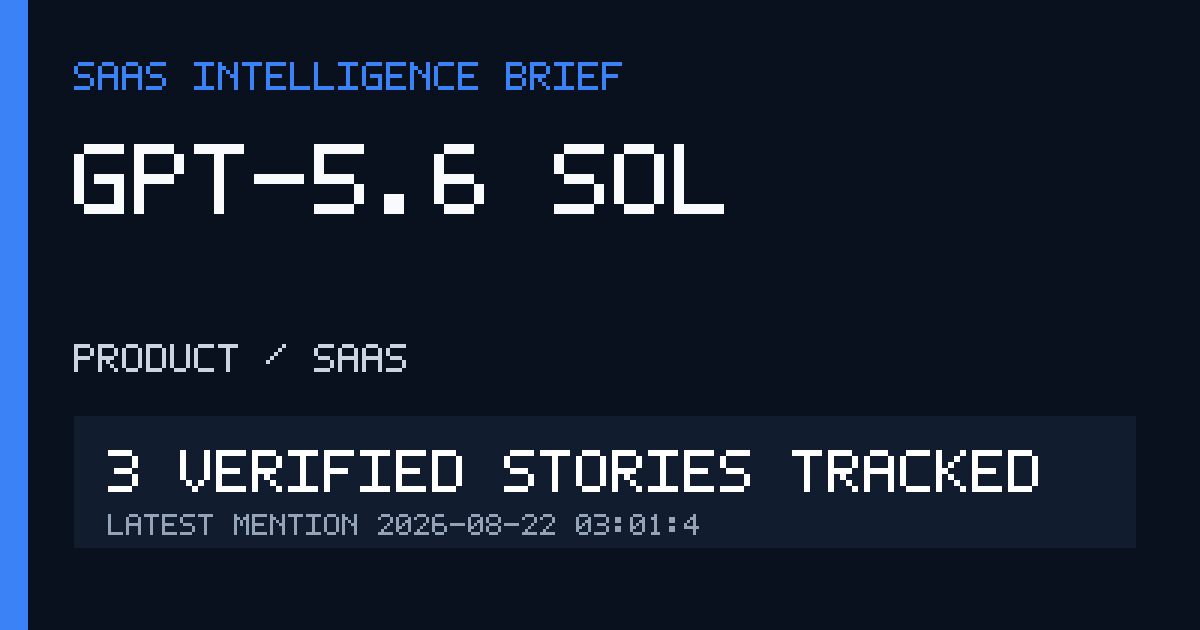
Anthropic is the most frequent co-covered peer, appearing in 3 of the 3 tracked stories. Source depth averages 12.7 original sources per story, versus 2.9 across the same-window beat baseline. The clearest coverage concentration is market-trends: 2 of 3 stories, with the rest divided among 1 other category.
Figures are computed live from our source-verified story record
— see our methodology for how impact and
sentiment are derived.
What the coverage shows about GPT-5.6 Sol
Anthropic is the most frequent co-covered peer, appearing in 3 of the 3 tracked stories. Source depth averages 12.7 original sources per story, versus 2.9 across the same-window beat baseline. The clearest coverage concentration is market-trends: 2 of 3 stories, with the rest divided among 1 other category. At 7.7, the average consequence score sits above the same-window beat average of 6.2. The 56-day window averages about 0.4 stories each week. This profile follows 3 SaaS stories mentioning GPT-5.6 Sol across the period from June 28, 2026 to August 22, 2026.
Stories tracked
3
Per week
0.4
Sources per story
12.7
Computed from the 3 stories linked to this entity, with beat comparisons drawn from all 352 SaaS stories published in the same date window. Shares are omitted below five stories and comparisons below a twenty-story baseline.
Coverage cohort
Appears alongside
Other entities that clear the same relevance threshold in stories also covering GPT-5.6 Sol. Shared-story counts are live from our verified record — not editorial picks.
OpenAI reduced GPT-5.6 Sol API pricing more than 20% for three months, cutting output tokens 33% to $20 per million. SaaS platforms embedding frontier AI — from agentic copilots to code assistants — see a direct reduction in inference COGS and a window to lock in lower costs.
Moonshot AI’s Kimi K3, an open-weight model with 2.8 trillion parameters, matched the best US proprietary systems and topped Arena.ai’s web-interface benchmark. For SaaS vendors embedding AI, this means a viable alternative to expensive closed APIs—potentially slashing integration costs while enabling deep customization on private infrastructure.
The sudden restriction of frontier AI models to government-approved partners reshapes the enterprise SaaS landscape, with OpenAI’s GPT-5.6 Sol available to only 20 customers. This disrupts typical AI-as-a-service adoption and raises concerns about revenue cycles and competitive positioning in the cloud AI market.
GPT-5.6 Sol is linked from 3 stories on this site, each scored at or above our 35% relevance threshold — see how these pages are built.
See something wrong on this page — a misattributed entity, a wrong stat, a broken source
link? Report a data issue.